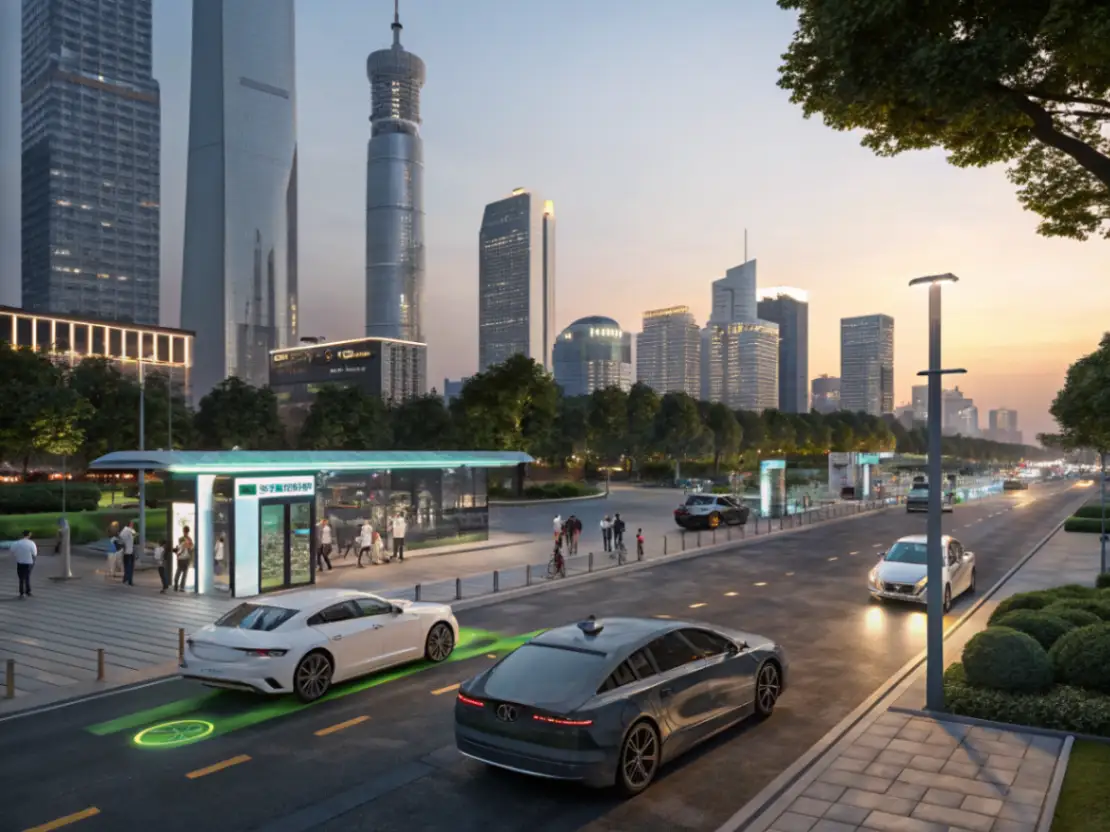
Cities are changing faster than at any point in the last few decades. Roads are becoming more crowded, logistics chains are under pressure, fuel prices remain unpredictable, and governments are tightening environmental regulations across entire industries. At the same time, artificial intelligence has matured from an experimental technology into a practical business tool capable of transforming transportation systems in real time. These two forces — sustainability and automation — have merged into one of the most attractive investment areas in the global market.
Investors are no longer looking at transport as a traditional infrastructure sector with slow growth and limited innovation. AI-driven mobility companies now operate at the intersection of software, energy, robotics, data analytics, and urban development. That combination creates opportunities for recurring revenue, scalable platforms, and long-term influence over how people and goods move around the world.
Green mobility is also benefiting from a major shift in consumer expectations. Electric vehicles, smart logistics, autonomous delivery systems, and connected urban transport are increasingly viewed not as futuristic concepts but as necessary solutions to real economic and environmental problems. Capital naturally follows sectors that solve large-scale challenges while opening new commercial markets, and AI transport sits directly in that category.
The rise of intelligent mobility ecosystems
Transportation used to depend mostly on hardware. Manufacturers built cars, governments built roads, and logistics companies managed fleets manually. AI has fundamentally changed that model by turning mobility into a data-driven ecosystem.
Modern transport systems generate enormous volumes of information every second. Sensors inside vehicles monitor driver behavior, battery performance, traffic conditions, weather patterns, fuel consumption, and route efficiency. AI systems process this information instantly and make decisions that improve efficiency without requiring human intervention.
For investors, this matters because software-driven systems are easier to scale than purely physical businesses. A company that develops AI traffic optimization tools can deploy its technology across hundreds of cities without rebuilding infrastructure from scratch. A logistics platform powered by predictive algorithms can improve delivery efficiency globally while continuously learning from new data.
This scalability is one of the main reasons venture capital firms and institutional investors are aggressively entering the mobility sector. They see opportunities similar to the rise of cloud computing and fintech: industries once dominated by traditional infrastructure are being reshaped by intelligent software layers.
The strongest companies in this space are not simply building electric cars or transport apps. They are creating connected ecosystems where AI coordinates multiple components simultaneously:
• Smart charging networks for electric vehicles.
• Predictive maintenance systems for fleets.
• Autonomous delivery platforms.
• Real-time traffic management software.
• AI-powered public transport optimization.
• Energy-efficient route planning tools.
These systems create recurring streams of valuable operational data. That data becomes a strategic asset because it improves algorithms over time, making the platform more effective and harder for competitors to replicate.
Investors also recognize that governments increasingly support intelligent transport projects through subsidies, tax incentives, and infrastructure funding. Public policy is accelerating private investment rather than slowing it down, which creates a more stable environment for long-term capital deployment.
Why sustainability has become a financial priority
Environmental concerns are no longer treated as separate from business performance. Large investment firms now evaluate climate exposure as part of standard financial risk analysis. Transportation plays a major role in this shift because it remains one of the largest sources of global carbon emissions.
Green mobility companies offer investors exposure to industries expected to grow for decades as countries move toward lower-emission economies. Electric transport alone represents a massive transition involving vehicles, batteries, charging systems, energy storage, software infrastructure, and smart grid integration.
The financial appeal is not based only on environmental branding. Sustainable transport technologies can reduce operational costs significantly. Electric fleets often require less maintenance than combustion-engine vehicles. AI route optimization lowers fuel and electricity consumption. Smart logistics systems reduce wasted trips and improve fleet utilization.
Before looking deeper at the investment logic behind the sector, it helps to compare how AI and green mobility technologies directly influence business performance.
| Technology Area | Business Impact | Investor Interest |
|---|---|---|
| AI route optimization | Lower delivery and fuel costs | High recurring SaaS potential |
| Electric vehicle fleets | Reduced maintenance expenses | Long-term infrastructure growth |
| Autonomous logistics | Lower labor dependency | Massive scalability opportunity |
| Smart traffic systems | Improved urban efficiency | Government-backed expansion |
| Predictive maintenance | Reduced downtime | Strong enterprise demand |
| Shared mobility platforms | Better asset utilization | Subscription-based revenue models |
These advantages explain why sustainable transport is increasingly viewed as an efficiency upgrade rather than simply an environmental initiative. Investors prefer sectors where ethical goals align naturally with profitability, and green mobility is becoming one of the clearest examples of that alignment.
Large corporations are also under pressure from shareholders and regulators to reduce emissions across supply chains. That pressure creates demand for AI-driven fleet management, cleaner delivery systems, and low-emission logistics solutions. Investors understand that companies helping enterprises meet sustainability targets are likely to secure long-term contracts and stable revenue streams.
Consumer behavior reinforces this trend. Buyers increasingly prefer brands associated with sustainability, especially younger demographics in major urban markets. Mobility companies that combine convenience with environmental responsibility are attracting stronger customer loyalty and broader public support.
AI is transforming logistics into a high-margin industry
Logistics has historically operated on relatively thin profit margins. Fuel costs, labor expenses, delays, inefficient routing, and inventory problems often reduced profitability even for large operators. AI is changing the economics of the industry by making logistics far more predictable and efficient.
Machine learning systems can analyze historical delivery data alongside real-time traffic, weather conditions, warehouse capacity, and customer demand. This allows logistics companies to make smarter decisions automatically. Routes are adjusted dynamically, idle time is reduced, and vehicles consume less energy.
For investors, the attraction is straightforward: small efficiency improvements at large scale create enormous financial impact. Saving even a few percentage points in fuel or labor costs across thousands of vehicles translates into millions of dollars annually.
Autonomous delivery technologies add another layer of interest. Self-driving trucks, robotic warehouse systems, and AI-assisted last-mile delivery platforms could dramatically reduce operational costs over time. While fully autonomous transport still faces regulatory and technical challenges, investors are funding the sector aggressively because even partial automation creates measurable gains.
The growth of e-commerce has intensified this opportunity. Consumers now expect rapid deliveries, accurate tracking, and flexible shipping options. Traditional logistics systems struggle to maintain profitability while meeting these expectations. AI allows companies to scale operations without proportionally increasing costs.
Another reason investors are optimistic about AI logistics is the resilience factor. Global supply chain disruptions exposed weaknesses in traditional transport models. Companies capable of using predictive analytics to adapt quickly during disruptions gained a major competitive advantage. Investors increasingly prioritize businesses that can respond intelligently to instability rather than relying on rigid operating structures.
AI-powered logistics also creates opportunities beyond transportation itself. The surrounding ecosystem includes warehouse automation, smart inventory management, fleet analytics, energy optimization, and industrial robotics. This interconnected market attracts investors seeking diversified exposure within one rapidly expanding sector.
Urban mobility is becoming a technology platform
Cities are under enormous pressure to modernize transportation systems. Population growth, traffic congestion, pollution, and infrastructure limitations create problems that traditional urban planning struggles to solve. AI mobility platforms offer governments and private operators new ways to manage transportation more efficiently.
Urban mobility now extends far beyond buses and train systems. It includes ride-sharing networks, electric scooters, bike-sharing platforms, autonomous shuttles, intelligent parking systems, and integrated payment applications. AI acts as the coordination layer connecting all these services together.
Investors are especially interested in mobility platforms that can become deeply embedded in city infrastructure. Once a transport system integrates into daily urban operations, replacing it becomes difficult. That creates long-term commercial stability.
Several factors make urban mobility particularly attractive for capital allocation:
• Cities continue expanding globally at a rapid pace.
• Governments actively fund smart city initiatives.
• Public transport systems require modernization.
• Congestion creates economic losses that cities want to reduce.
• Citizens increasingly prefer flexible transport access over car ownership.
The shift from ownership to access is especially important. Younger consumers in many cities are less interested in purchasing vehicles and more interested in convenient mobility subscriptions. This creates opportunities for recurring revenue models similar to streaming services or cloud software platforms.
AI enhances these systems by improving coordination between different forms of transportation. Algorithms can predict passenger demand, adjust vehicle availability, optimize traffic signals, and reduce waiting times dynamically. The result is a transport network that operates more efficiently while improving user experience.
Investors also understand that smart mobility generates valuable behavioral data. Knowing how people move through cities has commercial applications across retail, advertising, urban planning, and real estate development. Mobility companies therefore hold strategic information that extends beyond transportation itself.
This convergence of transport, software, infrastructure, and consumer behavior explains why technology investors increasingly view urban mobility as a platform economy rather than a traditional transportation business.
The role of regulation and public policy
Government policy plays a larger role in mobility investment than in many other technology sectors. Regulations can either accelerate adoption or slow deployment significantly. In recent years, most major economies have moved toward policies that support sustainable and AI-enabled transportation.
Emission targets are becoming stricter across Europe, North America, and parts of Asia. Many governments have announced long-term plans to phase out combustion-engine vehicle sales or dramatically reduce urban emissions. These policies create predictable demand for electric transport infrastructure and related technologies.
Public funding has also expanded. Governments are investing in charging networks, renewable energy integration, smart road systems, and digital transport infrastructure. This reduces risk for private investors because public spending often helps establish the foundational ecosystem required for commercial growth.
At the same time, AI regulation is pushing companies toward higher standards of safety and transparency. While some investors worry about compliance costs, others see regulation as beneficial because it can eliminate weaker competitors and strengthen trust in the sector.
Institutional investors particularly value markets with clear regulatory direction. When governments publicly commit to sustainability goals over ten or twenty years, investors gain confidence that demand for green mobility solutions will continue expanding.
Public-private partnerships are becoming more common as well. Cities frequently collaborate with technology firms to deploy smart traffic systems, electric bus fleets, or autonomous transport pilots. These partnerships create large-scale commercial opportunities that smaller startups could not achieve independently.
Insurance and financial industries are also adapting to the mobility transition. AI-assisted driving systems may reduce accident rates over time, while electric fleets can alter maintenance and depreciation models. Investors recognize that transportation innovation influences multiple industries simultaneously, increasing the overall scale of the opportunity.
Why long-term investors see massive growth potential
Many investors are drawn to AI transport and green mobility because the sector combines several global megatrends at once. Urbanization, automation, decarbonization, digitalization, and energy transformation are all converging inside modern transportation systems.
This convergence creates unusually broad growth potential. AI mobility is not limited to one product category or regional market. It affects passenger transport, freight logistics, public infrastructure, energy systems, insurance, retail distribution, and industrial operations.
Long-term investors are especially interested in markets capable of compounding over decades. Mobility transformation is expected to continue far beyond the current investment cycle because transportation infrastructure changes slowly and requires ongoing modernization.
The sector also benefits from strong network effects. As more electric vehicles enter the market, charging infrastructure becomes more valuable. As AI systems collect more mobility data, their algorithms improve. As smart city platforms expand, they attract additional services and users. These reinforcing dynamics can create dominant market leaders with durable competitive advantages.
There is also growing recognition that transportation innovation influences economic productivity at a national level. Faster logistics, reduced congestion, and more efficient supply chains improve overall economic performance. Governments therefore have strong incentives to encourage continued investment in intelligent mobility systems.
The companies attracting the most attention are usually those combining practical utility with scalable technology. Investors increasingly avoid purely speculative concepts and focus instead on businesses solving measurable operational problems. AI transport succeeds because it improves efficiency, reduces costs, lowers emissions, and responds to changing consumer expectations simultaneously.
Market volatility may continue in the short term, especially as competition intensifies and regulations evolve. Some companies will fail, and certain technologies may develop more slowly than expected. Even so, most analysts agree that the long-term direction of the industry is clear: transportation is becoming cleaner, more connected, more automated, and more intelligent.
Conclusion
AI transport and green mobility have moved far beyond trend status. Investors see them as foundational parts of the next industrial transformation, comparable to the rise of the internet economy or cloud computing. The sector combines environmental relevance with practical commercial value, which makes it unusually attractive for both private and institutional capital.
Artificial intelligence is helping transport systems become more efficient, predictable, and scalable. Green mobility technologies are reducing emissions while improving operational economics. Together, these innovations are reshaping logistics, urban infrastructure, consumer behavior, and industrial operations.
What makes the sector particularly powerful is its ability to connect multiple global priorities at once. Governments want cleaner cities. Businesses want lower operating costs. Consumers want convenience and flexibility. Investors want scalable growth markets with long-term demand. AI-driven mobility addresses all of these goals simultaneously.
The companies leading this transformation are not simply building vehicles or transport apps. They are constructing intelligent ecosystems capable of influencing how entire economies move, deliver goods, consume energy, and organize urban life. That scale of impact explains why investment momentum in AI transport and green mobility continues accelerating across global markets.